
On a construction or EPC project the money does not arrive when the job is done — it arrives in instalments, against measured progress, over months or years. That changes everything about how you bill. A single invoice at hand-over is replaced by a stream of milestone and running-account claims, each one a small negotiation with a client who is measuring, checking and holding back retention. The contractors who get paid on time are not the ones with the best excuses; they are the ones whose every claim is built from the same tasks and resources the work was planned against, so it can be justified line by line.
This article is written with construction and EPC in mind, because that is where progress and RA billing is a way of life. But the mechanics apply to any milestone-billed project — an engineer-to-order machine billed on design, dispatch and commissioning; a fabrication job billed by weight delivered. Fast Project Management serves all of these, cloud or on-premise, across India and worldwide. If you have not yet broken your project into tasks, start with What is a Work Breakdown Structure?; for the wider picture, see the pillar guide, What is project management software?
Progress billing, RA bills and retention are the daily language of construction and EPC — but the underlying idea, billing a project in defensible stages from resource-itemised, task-linked data, is the same for any build-to-order business that gets paid in instalments.
1. Why project billing is different
A product sale is billed once: goods dispatched, invoice raised, done. A project is billed in stages, and that single difference drives everything else. Because payment is spread across the life of the project, each claim has to answer a harder question than "what did we sell" — it has to answer "how much of this project have we actually completed, and what are we entitled to be paid for it right now?"
Three things make project billing its own discipline:
- It is measured, not fixed. A milestone or RA claim is based on work actually done to a point in time — measured, checked and often certified — not on a pre-agreed lump sum that ignores reality.
- It is cumulative. Especially on RA bills, each claim is the cumulative value of work done less everything already billed, so bills interlock and cannot double-count.
- It carries retention and conditions. The client holds back a slice as security, and payment is conditional on certification — so the amount claimed and the amount due are not the same number.
Get billing built on the same task and resource data the work was planned and executed against, and all three become straightforward. Build it in a separate spreadsheet, disconnected from the project, and every claim becomes an argument.
2. Billing by project, resource or milestone
The foundation that makes staged billing possible is that project bills are resource-itemised and keyed to tasks. Because the bill is built from the same tasks and priced resources the project was planned with, the very same data can be sliced three ways depending on how the contract pays:
| Bill by… | What it claims | Best when |
|---|---|---|
| Project | The whole project, or a defined lump-sum stage of it | Short jobs or fixed-price stages billed as a whole |
| Resource | The material, labour and machine actually consumed | Cost-plus or rate-based contracts, or measured item work |
| Milestone | A defined set of completed tasks — a stage reached | Contracts that pay on design, dispatch, erection, commissioning |
The point is not that one is right — it is that all three read from one structure. A project bill header carries the party and the amount; its lines carry the task, the resource group and code, the quantity, unit, rate and amount. Whether you are claiming a milestone, a resource-measured quantity or a whole stage, you are filtering and totalling the same underlying tasks — which is exactly why every claim traces cleanly back to the work behind it. See Project & Milestone Billing.
3. Progress and RA (running-account) bills
The workhorse of construction billing is the RA bill — a running-account progress bill raised at intervals for the cumulative work done to date. Each RA bill follows the same disciplined sequence, and understanding it is the key to getting paid without disputes.
- Read progress against the project's tasks and measured items
- Base the claim on what is actually complete, not what was hoped
- Capture it against the same tasks the work was planned on
- Apply the contract rates or the resource-itemised BOR values
- Total the cumulative value of work done so far
- Every line ties to a task and a priced resource
- Deduct the value of all previous RA bills on the project
- What remains is the gross value of this bill
- Cumulative accounting means no line is ever double-claimed
- Withhold retention per the contract percentage
- Apply any advances, deductions or agreed adjustments
- The net is what is actually due on this bill
- Produce the printable bill with its full breakdown
- Submit for the client's measurement and certification
- Hand the certified receivable to accounts
4. Retention basics
Retention is the portion of every bill the client holds back as security — typically a percentage — released only when the project is complete or a defect-liability period ends. It exists to protect the client, and it is a normal, contractual part of how construction and EPC pay. What matters operationally is handling it on the bill itself, not as a separate reconciliation.
On a progress or RA bill, the value claimed is the work done less the retention withheld, so the contractor is paid most of the value now and the retained balance later against the agreed conditions. Tracking retention as a line on each bill — and the cumulative retention held across all bills — keeps the claim and the receivable consistent. The alternative, reconciling retention in a spreadsheet away from the bills, is where disputes over "how much are you actually holding" begin.
- A retention line on every RA bill
- Claimed value less retention = net due
- No separate reconciliation to drift
- Cumulative retention tracked across bills
- Released on completion or end of defect period
- Claim and receivable stay consistent
5. Subcontractor bill passing against a PO
Most construction and EPC projects are delivered partly by subcontractors, and money flows the other way too: subcontractors raise bills for the work they have done, and the main contractor must check and clear them. Bill passing is that controlled process — matching a subcontractor's bill against their purchase order and the work actually completed, then clearing it for payment.
Doing this against the PO, on the same platform that runs the project, is what keeps it honest. A subcontractor bill can be matched to what was ordered (the PO), what was delivered (the recorded work), and what remains — so over-claims are caught before payment, not after. Passing and clearing subcontractor bills on the same engine that raises the client RA bills means the money coming in and the money going out are visible together, on the project they belong to. See Fast Billing & Accounts and Inventory & Procurement.
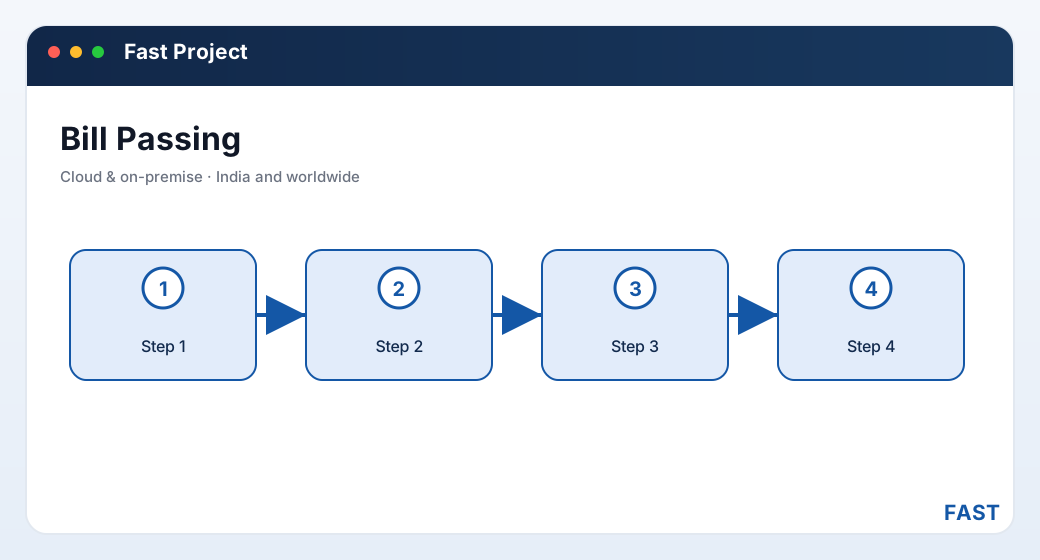
Bill passing is a three-way match: what was ordered on the PO, what was actually done, and what the subcontractor has claimed — cleared for payment only when the three agree.
6. Making a claim defensible
Everything above comes down to one goal: a claim the client cannot reasonably dispute. A defensible bill has four properties, and they all come from building the bill on project data rather than beside it:
- It is measured. The claim reflects work actually completed against the project's tasks, not an estimate of progress.
- It is itemised. Every line ties to a task and a priced resource, so the client can check any figure against the work behind it.
- It is cumulative and clean. Previous bills are subtracted, retention is shown, and nothing is double-counted — the arithmetic is transparent.
- It is traceable. Because the bill reads from the same records as the plan and the cost, any queried line leads straight back to the task, the resource and the rate.
When a bill has these four properties, certification is faster and payment follows. When it does not — when the claim is a hopeful number in a spreadsheet with no line-level backing — every RA cycle turns into a round of queries, and cash gets stuck.
7. Common billing traps that stall payment
The same avoidable mistakes hold up project payments again and again. Knowing them is half of avoiding them:
- Billing disconnected from the plan. When the bill lives in a spreadsheet with no link to the project's tasks and resources, every line is unbacked and every query is slow to answer.
- Losing track of cumulative value. If previous RA bills are not cleanly subtracted, claims either double-count (and get rejected) or under-claim (and leave cash on the table).
- Reconciling retention separately. Retention held in a side spreadsheet drifts from the bills, and the "how much are you holding" argument follows.
- Passing subcontractor bills without the PO. Clearing a subcontractor bill without matching it to the order and the work invites over-payment and erodes margin quietly.
- No line-level traceability. A claim the client cannot drill into is a claim the client will delay — certification stalls on figures nobody can substantiate.
8. How Fast Project Management does it
Fast Project Management Software is the project and ETO-execution product of the Fast Suite, built in Pune by Improsys under the Fast Technology brand and available cloud or on-premise. It implements project and progress billing with real, named screens:
| Capability | How Fast Project Management does it |
|---|---|
| Resource-itemised bills | A project bill header carries the party and amount; its lines carry the task, resource group and code, quantity, unit, rate and amount — so bills are built from the same tasks and resources the work was planned on. See Project & Milestone Billing. |
| By project, resource or milestone | Because bills are keyed to tasks, the same data can be billed as a whole project, by the resources consumed, or as a defined milestone stage — whichever the contract pays on. |
| Progress / RA bills | Running-account progress bills value cumulative work done, net of what was previously billed, so a long project is billed at intervals against measured progress. |
| Retention | Retention is handled on the bill so the claimed value less retention is the net due, and cumulative retention is visible across the project rather than reconciled separately. |
| Subcontractor bill passing | Subcontractor and supplier bills are passed and cleared against their purchase order on the same platform, so what was ordered, delivered and claimed can be matched before payment. See Fast Billing & Accounts. |
| Printable bill & handoff | Each bill produces a printable document for certification, and posts alongside the platform's invoicing on the same party master — so the certified receivable is one record, not two. See Inventory & Procurement. |
Bill by milestone, RA or resource — every claim traced to the tasks behind it.
Fast Project Management runs the whole billing chain — resource-itemised project bills, progress and RA bills with retention, and subcontractor bill passing against a PO — all built from the same tasks and resources the project was planned and costed with. Because it shares one platform and one party master with the rest of the Fast Suite, the money in and the money out sit on the same project, cloud or on-premise, serving construction, EPC and every build-to-order business across India and worldwide.
9. Frequently asked questions
Bill your project the way the contract pays
A 30-minute demo — your project billed by milestone, RA or resource, with retention and subcontractor bill passing, live on screen. Cloud or on-premise.