Break each project into a WBS, schedule it on a Gantt with dependencies, plan and cost it with a per-task Bill of Resources, track progress to completion, and bill by project, resource or milestone.
When every project lives in separate spreadsheets, you can't see where the time and money are really going until the damage is already done.
A task quietly slips, then another, and suddenly the whole project is late — with no early warning to act on.
Extra material and hours pile up across the job, and you only find out you've overspent when you add it all up at the end.
Milestones get missed or forgotten, so you invoice late, under-bill the work done, and wait even longer to get paid.
Fast Project Management Software breaks each project into clear tasks on a simple timeline, works out what each task will cost, and tracks progress as the work gets done. When a stage is finished, it's ready to bill straight away — so nothing slips through and no work goes unpaid.
Break the project into steps on an easy Gantt chart, with clear start and finish dates and what depends on what.
A per-task list of people, machines and materials shows what the project should cost, so you can compare planned against actual.
As each stage is completed, raise the bill for exactly that work — by project, resource or milestone.
Spot slips early on the Gantt and act before one late task drags the whole project down.
Watch actual spend against budget at every step, so overruns get caught while you can still fix them.
Milestones are tracked all the way to the bill, so you invoice on time and never under-bill the work you've done.
Everyone works from the same up-to-date project picture instead of chasing status across emails and spreadsheets.
Fast Project Management Software carries every engineered or fabricated order through one controlled cycle, from a planned WBS on the Gantt to a milestone bill raised against the work done — with cost estimated against budget at every step.
Everything starts with the project — a bespoke order, a fabrication job, an engineering package. You create a project header with owner, customer, type, start and finish dates, budget and priority, and it lives on a lifecycle board with Active, On Hold, Completed and Inactive tabs, each carrying its own progress %.
You then break the project into a Work Breakdown Structure of tasks. Each task carries its own owner, assigned user, priority, dates, budget and progress %, linked by predecessor dependencies that establish sequence. Every task accumulates dated logs and file attachments — drawings, approvals, inspection records — so the WBS is both the plan and the record.
Read more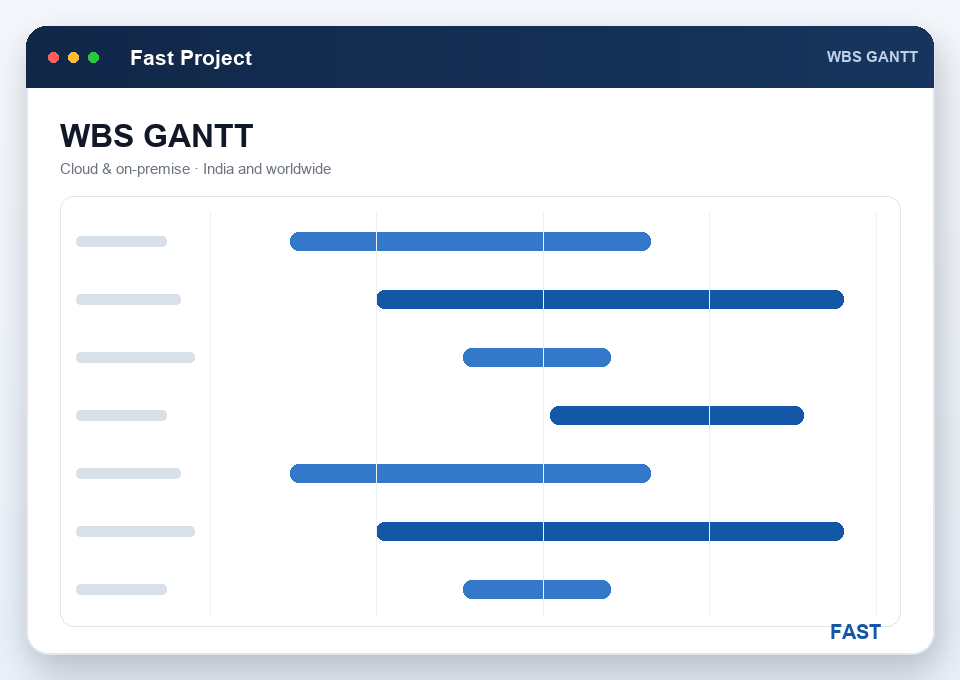
Every WBS task is drawn as a bar on an interactive Gantt chart, positioned by its start, finish and duration. Predecessor dependencies link the bars so the schedule sequences correctly — design before fabrication, fabrication before assembly — and the critical path is visible at a glance.
There are two views: an order-planning Gantt for the overall schedule and a resource-wise Project Gantt Chart that shows loading by resource. Reschedule by adjusting task dates, and the plan updates — so the Gantt stays the live schedule dashboard the project runs on.
Read more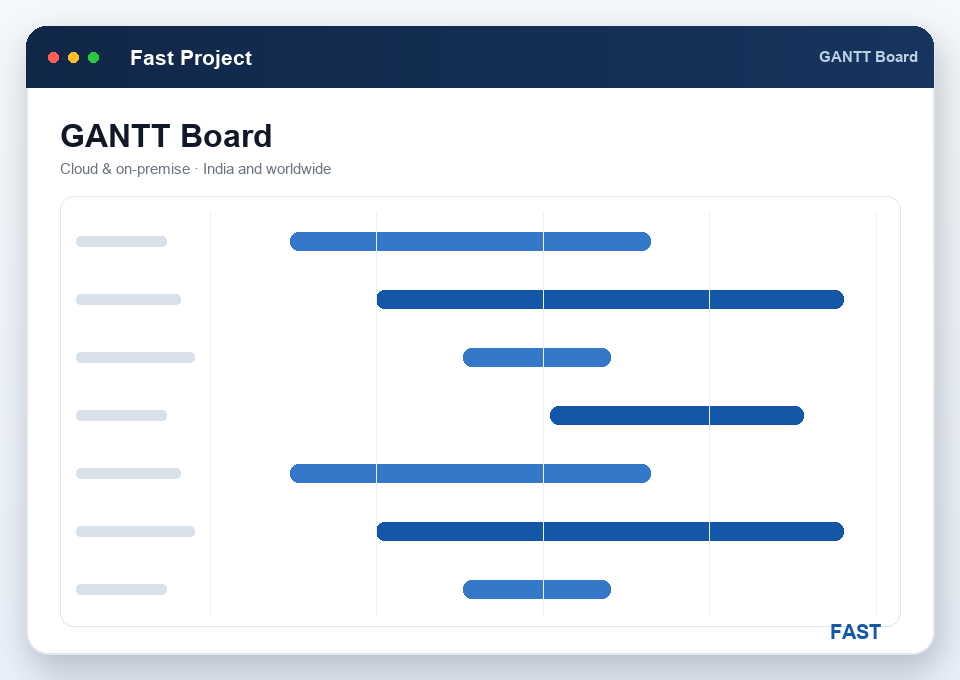
Each task gets its own Bill of Resources, built in a header-to-process-to-resource structure: the material, labour and machine lines it consumes, each with a quantity and a rate. Rates come straight from the Resource master, where machines, labour and tools carry their price, working hours and efficiency, grouped by category and type.
Roll the BOR quantities against their rates and you get an estimated cost per task, and a master roll-up BOR for the whole project — compared line by line against the budget. Cost estimation and the BOR cost breakdown show where a job is heading over budget while there is still time to act.
Read more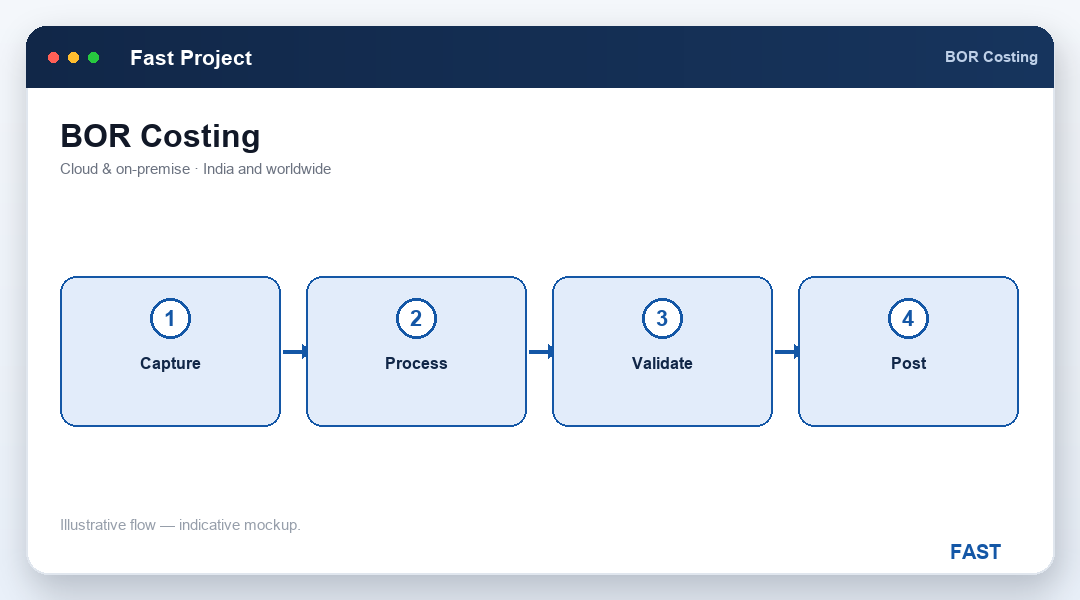
When work reaches a billable stage, you raise a project bill: a bill header with the party and project details, and resource-itemised lines keyed to tasks — resource group, code, quantity, unit and rate. That lets you bill by project, by resource, or by milestone, including progress and RA (running-account) bills as a job advances.
The same screen passes subcontractor and supplier bills against a purchase order, with clearance tracking, so incoming and outgoing bills sit in one place. Every bill prints to a clean PDF and hands off to Fast Billing — no re-keying, one party and item master across the suite.
Read more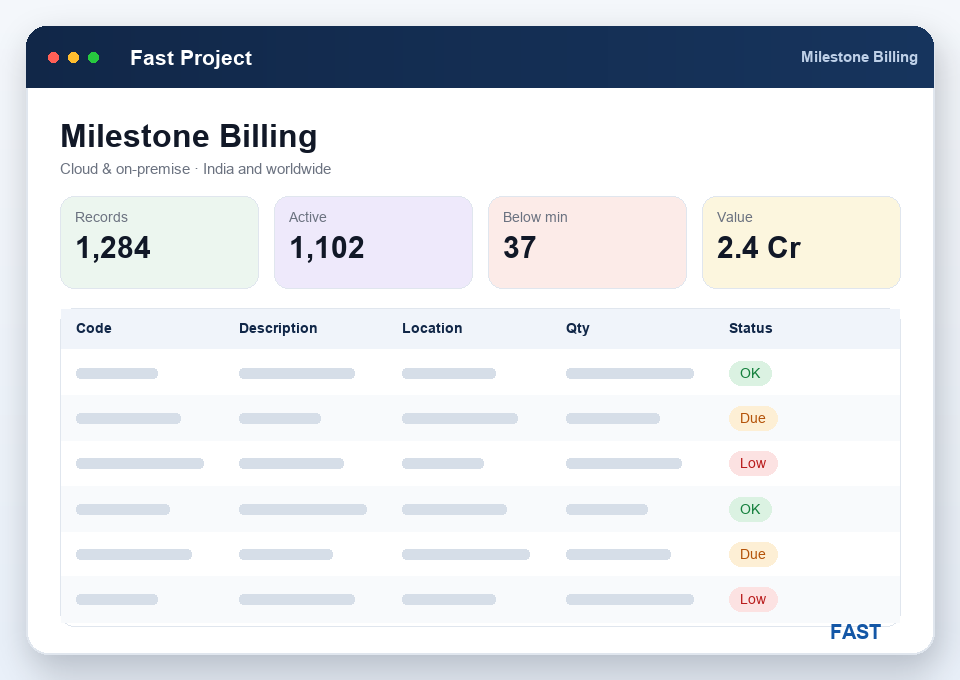
Fast Project Management Software ships with the dashboards and MIS a project business actually runs on — portfolio status, task progress, the Gantt, cost estimation vs budget, resource loading and project billing — plus Dhruv AI, our own AI layer for the questions a fixed report can't answer.
The control tower — every project by status across Active, On Hold, Completed and Inactive, with owner, customer, budget and progress %, all on one screen for the manager who owns the portfolio.
The live position of every WBS task — owner, assigned user, dates and progress % — with dated task logs and the file attachments that record what was done.
The interactive Gantt as the schedule dashboard — task bars by start, finish and duration, predecessor sequencing and the critical path, in order-planning and resource-wise views.
Roll the task BOR quantities against their resource rates into an estimated cost per task and per project — compared line by line against budget, the basis for margin and overrun control.
The task and master roll-up Bill of Resources — material, labour and machine with quantities and rates — so the whole project's resource requirement and cost is visible in one report.
Resource-wise loading from the resource master — which machines, labour and tools are committed to which tasks and when — so you spot over-allocation before it stalls the schedule.
Resource-itemised project bills by project, resource or milestone, and progress/RA bills as a project advances — every bill keyed to the tasks it covers.
Subcontractor and supplier bills passed and cleared against a purchase order — with a supplier bill report — so incoming project costs sit alongside what you bill the client.
Dhruv AI, our own AI engine, turns a plain-English question — "which projects are over budget?" or "which tasks are slipping?" — into a safe, read-only query and answers with the data and a summary.
Fast Project Management is the project and ETO execution profile of one platform of 12 integrated Fast Technology products. It shares the same Resource and Item master and store engine as Fast Production, Fast Inventory and Fast Billing — so a project can issue stock against a task, raise a project purchase requisition, and hand its bills to accounts with zero double entry.
The sister profile. Standard BOM and work-order manufacturing runs alongside project work on the same Resource and Item master — one shop, both modes.
Same stock engine. Material issued against a task and project purchase requisitions post to the on-hand your stores team already sees.
The money side. Project, milestone and subcontractor bills hand off to Billing on one party master — no re-keying between project and accounts.
Upstream demand. Material and resource requirements from the project plan feed procurement and scheduling on the same masters.
Where projects begin. A won enquiry or client order becomes a project, tying delivery straight to the customer it is for.
The full superset. Projects link to the same customers, items, stores and accounts your whole ERP runs on.
We map your project process first — how projects are planned, how the WBS is built, how resources are costed, how progress and bills are tracked, gap analysis. Then we configure Fast Project Management Software to fit how you deliver projects. Not the other way around.
Post go-live is not where we disappear. Dedicated support team, multiple channels, monthly review meetings, and patches issued on feedback. We treat support as part of the product.
Engineer-to-order and custom manufacturers, fabrication and job-work shops, and EPC and engineering teams each run every order as a project. Fast Project Management Software serves each with the WBS depth, Gantt scheduling, Bill of Resources and milestone billing a build-to-order business needs — and construction and real estate teams too.
Each bespoke, engineered order run as its own project — a WBS of design, fabrication and assembly tasks, a per-task Bill of Resources, cost-vs-budget and a resource-itemised bill.
Structural, sheet-metal and machining jobs quoted, planned into a WBS, resourced with steel, welding and machine time, tracked by progress and billed by milestone or resource.
Engineer-procure-construct packages planned as a WBS with dependencies, costed with a Bill of Resources against budget, and procured with project purchase requisitions.
Machine and capital-equipment builds carry a per-order WBS, a Bill of Resources, cost estimation against budget, procurement and milestone billing — from design to FAT and dispatch.
Site and tower projects broken into a WBS, scheduled on a Gantt, resourced with material, labour and plant, tracked by progress % and billed by progress/RA milestone.
Fit-out and MEP packages run as projects — WBS by area and trade, resource-wise Gantt loading, progress tracking and milestone bills with subcontractor bill passing.
Because Fast Project Management runs on the shared document engine, its integrations are native table-level links, not brittle interfaces. Store issue against a task and project purchase requisitions move real stock, project and subcontractor bills hand off to Fast Billing, and WhatsApp, email, SMS and Dhruv AI keep the team and the client informed. One backbone.
See all integrationsSee how Fast Project Management Software handles your exact project flow. Live demo, your WBS, your Gantt, your Bill of Resources, your questions. No generic slideshow.