
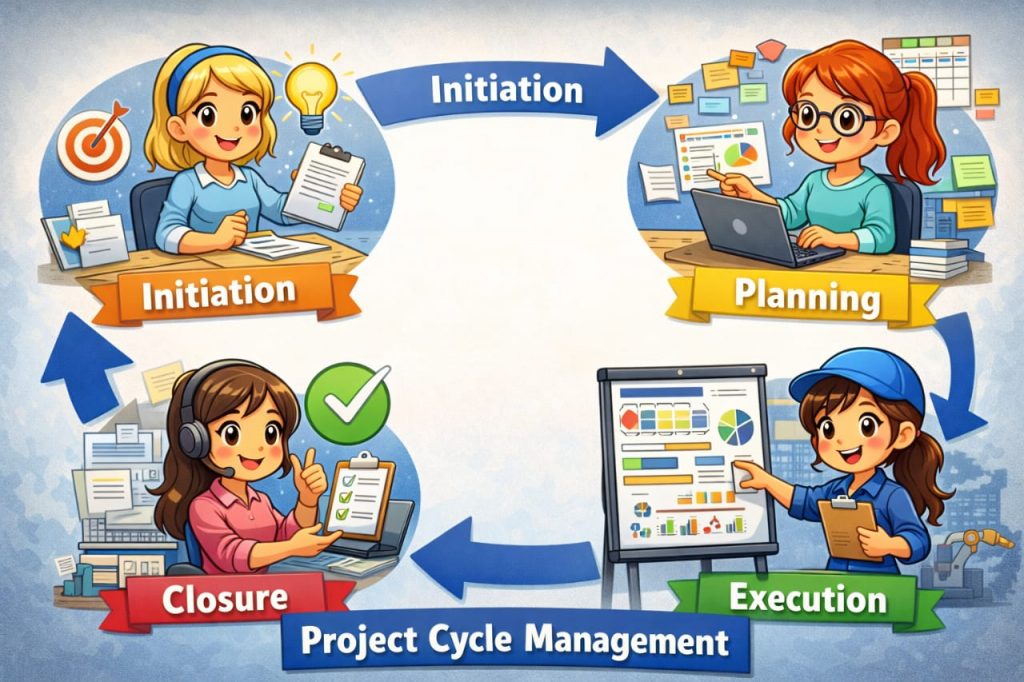
Project Cycle Management (PCM) is a structured approach to managing projects from initiation to completion,
ensuring that all stages are integrated and aligned with the project's goals.
It typically involves several phases:
- Understanding the situation: Assessing the context and needs.
- Project design: Planning the project and defining objectives.
- Approval and governance: Securing necessary approvals and establishing governance structures.
- Preparation: Finalizing plans and resources for implementation.
- Implementation and monitoring: Executing the project while tracking progress and making adjustments as needed.
- Evaluation: Assessing the project's outcomes and learning for future projects.
This systematic approach helps ensure efficiency, effectiveness, and successful outcomes in project management.
Project cycle management (PCM) is a project management approach that addresses the complexities of a project through all of its phases while maintaining alignment with the strategy and objectives agreed upon by stakeholders at the onset.
PCM helps with structuring and determining the phases of the project and how to approach tasks in those phases. It also assists in planning and review and can be used when managing multiple projects.
Project cycle management is a methodology for managing projects. It provides structure to the process, but also includes consulting stakeholders and providing them with relevant information throughout the life cycle of the project. This helps inform the best possible decisions.
The cycle of management operations within project cycle management is broken up into six phases:
- Programming: The programming phase asks what the developmental priorities are and comes to an agreement of a strategy paper and indicative program.
- Identification: The identification phase there needs to be the completion of the fiche, or financing proposal, after a delegation makes an initial assessment. The proposal is then accepted, modified or denied, and financing is committed or not.
- Formulation or Planning: The formulation phase determines if the project is feasible and if it will deliver on the benefits it proposes by completing the financing proposal, along with technical and administrative provisions.
- Implementation: If results are being achieved and resources are being used properly, there is a submission of an annual operating plan, as well as other monitoring reports and reviews to determine if financing needs to continue as planned or change to support new needs.
- Monitoring and Evaluation: Evaluation determines if the project achieved its planned goals by completing an evaluation study, which is planned and managed by a task manager.
- Closing: During the closing phase, an audit is conducted to determine if the project was completed in compliance with law and rules, and if other criteria have been met. The process is usually managed by an audit task manager.